Technical Parameter Comparison of Wrapper Leaf Thickness, Oil Content, and Combustion Characteristics
1. Starting from a Failed Combustion Test: The Cost of Parameter Loss of Control
In March 2024, our R&D center conducted a wrapper leaf matching test for a "light" product. We attempted to use an ultra-thin Shade leaf from the Connecticut region as a wrapper, trying to enhance the product's draw sensation through extreme thinness. Initial laboratory data was perfect: the combustion front advanced steadily, and smoke volume remained at extremely high levels during the first 5 minutes of testing.
However, at the 12-minute mark, the situation changed dramatically. The previously stable combustion curve suddenly showed a steep upward inflection point, with the burn rate instantly soaring from 0.75mm/min to 1.65mm/min. Subsequently, the product exhibited obvious "Tunneling" — the combustion front was no longer a uniform arc shape, but formed extremely high hot spots locally, causing the entire product to structurally collapse in less than 20 minutes.
The core reason for this failure was not the thickness itself, but our neglect of the fluctuation in oil content within that batch of thin wrappers and its coupling effect with thickness. When wrapper thickness drops below a critical threshold, the thermal buffering capacity provided by oil is extremely weakened, and minor fluctuations in oxygen permeability are amplified several times by the missing thickness. This made me realize that wrapper research cannot be conducted in isolation — thickness, oil content, and combustion characteristics form a tightly coupled dynamic system.
2. Physical Dimension: Constraint Mechanism of Wrapper Thickness on Combustion Front
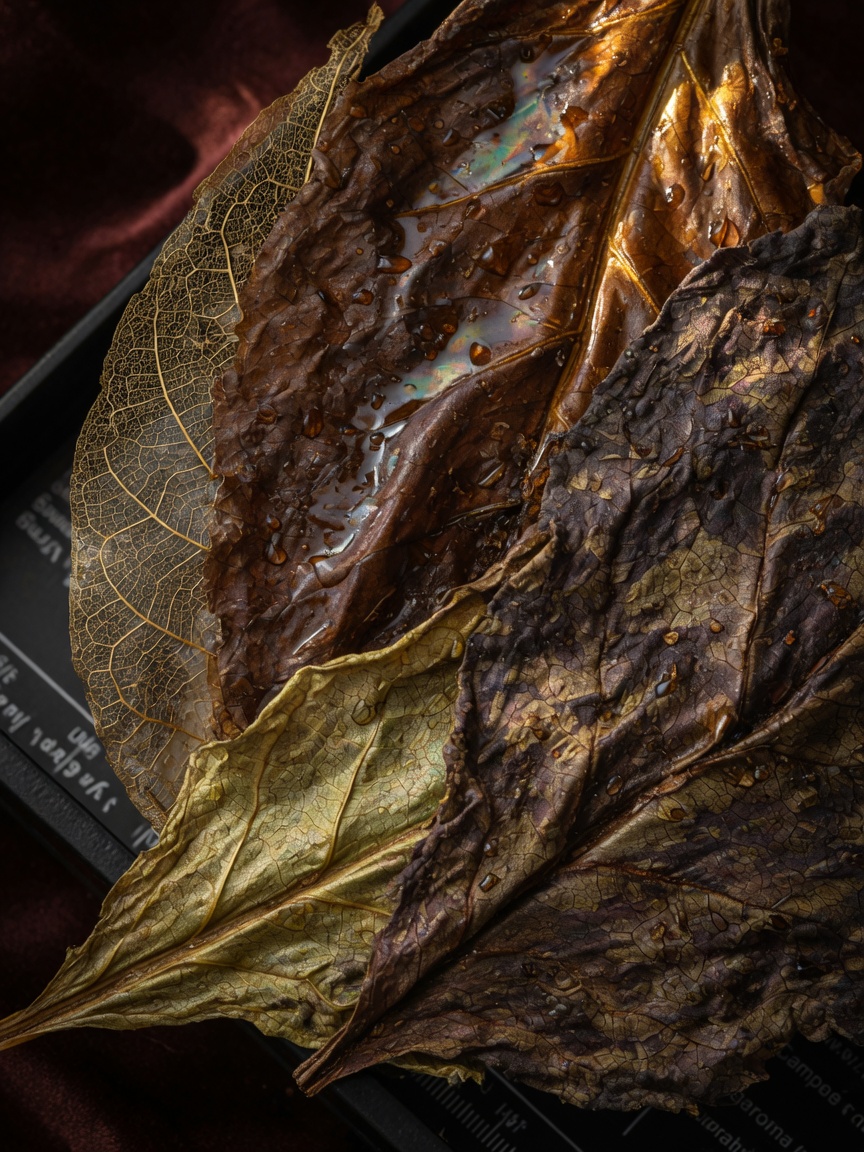
The role of the wrapper leaf in the combustion process is essentially that of a controlled "oxygen filter" and "heat conduction barrier."
2.1 Cellulose Density and Oxygen Permeability
The thickness of the wrapper directly determines the density distribution of the cellulose structure. Microscopically, thicker wrappers have more complex cell wall structures and longer fiber paths, forming a physical barrier that limits the rate of airflow toward the combustion core (Ember).
In our laboratory quantitative tests, we compared two typical wrapper types:
- **Type A (Thin Shade)**: Thickness approximately 0.12mm - 0.15mm.
- **Type B (Standard Sun-grown)**: Thickness approximately 0.22mm - 0.28mm.
Experimental data showed that Type A's Oxygen Permeability Coefficient is approximately 40% higher than Type B. This means that under the same draw frequency, Type A's combustion front faces a more abundant oxygen supply, directly leading to higher combustion temperatures. Under constant ambient temperature and humidity, Type A's average burn rate remained around 0.9mm/min, while Type B stabilized at 0.65mm/min.
2.2 Heat Conduction Path and Combustion Stability
Thickness also determines the heat diffusion path. Thicker wrappers can absorb instantaneous high temperatures generated by combustion through greater Thermal Mass, thereby evenly conducting heat to the surrounding fiber tissue. This "thermal buffering effect" allows the combustion front to present a stable, slowly advancing state.
Conversely, when thickness drops below 0.15mm, the heat conduction path shortens, and heat cannot effectively diffuse between fibers, causing heat to be highly concentrated locally. This is why thin wrappers are prone to "hot spots" and ultimately combustion runaway when faced with strong draws.
3. Chemical Dimension: Thermodynamic Analysis of Oil as a Combustion Regulator
If thickness determines the "skeleton" of combustion, then oil content determines the "blood" of combustion.
3.1 Phase Change and Thermal Buffering Effect of Oil
Oil is more than just a flavor carrier — it plays a critically important thermodynamic role in the combustion process. Oil is a complex mixture of organic compounds that undergoes a phase change from liquid to gas (Vaporization) in the high-temperature zone of the combustion front.
This phase change process is endothermic. At the combustion front, the evaporation of oil absorbs large amounts of thermal energy, acting as a "temperature regulator." High-oil wrappers (such as certain Maduro type leaves) consume a portion of the energy that would otherwise directly increase the combustion temperature. This effect manifests in experiments as: even with sufficient oxygen supply, the combustion temperature of high-oil wrappers remains 15°C - 25°C lower than that of low-oil wrappers.
3.2 Contribution of Oil to Smoke Volume and Density
The volatilization of oil directly affects the physical properties of smoke. When oil converts to gas during combustion, it not only carries complex aroma molecules but also increases the concentration of organic particles in the smoke, thereby enhancing the "density" of the smoke.
In our tests, we observed that wrappers with obvious "Oily Sheen" produced approximately 25% more smoke volume per unit time than dry wrappers. This increase is not simply due to larger smoke volume, but more importantly, the "body thickness" of the smoke is higher. This is because tiny droplets generated by oil vaporization increase the fluid's viscosity sensation in the smoke stream.
4. Parameter Coupling: Nonlinear Relationship Between Thickness, Oil Content, and Combustion Characteristics
In actual R&D, we frequently encounter various extreme parameter combinations, each producing completely different combustion behaviors.
4.1 "Thin and Oily": A Balance Point with High Technical Requirements
This is an extremely challenging combination. Thinness ensures a light draw sensation, while high oil content attempts to compensate for stability issues caused by missing thickness through thermal buffering.
In a 2023 R&D case, we attempted to control thickness at 0.14mm while increasing oil content through extended fermentation time. Results showed that although burn speed was controlled, the oil volatilization rate and the thin leaf's oxygen permeability created a "resonance," causing an unstable pulsation in smoke during the middle of combustion. This tells us that thin products have much higher requirements for oil distribution uniformity than thick products.
4.2 "Thick and Dry": The Trap of Slow Combustion
When wrapper thickness reaches above 0.25mm but oil content is extremely low, a "sluggish" combustion characteristic emerges. Due to the lack of thermal buffering and aroma carrier provided by oil, the combustion front advances very slowly, and because the cellulose is too thick, heat penetration is difficult, easily leading to combustion temperatures too low to effectively release the Filler's aroma. In this case, although smoke volume is large, it is extremely "thin" and lacks layering.
4.3 Key Parameter Comparison Table (Simulated Experimental Data)
"Thin and Oily" vs "Thick and Dry"
Thin & Oily (High Technical Requirement)
- Principle: Oil thermal buffer compensates for thinness
- Advantage: Light draw + controlled combustion
- Risk: Oil volatilization & oxygen create "resonance"
- Requirement: Extremely high oil distribution uniformity
Thick & Dry (The Trap of Slow Combustion)
- Principle: Thick cellulose + lack of oil thermal buffer
- Advantage: Large smoke volume
- Risk: Low combustion temp, aroma hard to release
- Result: "Thin" smoke lacks layering
| Wrapper Type | Thickness (mm) | Oil Content (%) | Burn Rate (mm/min) | Smoke Density (Rel) | Stability |
|---|---|---|---|---|---|
| Ultra-thin (Shade) | 0.13 | 5% | 1.15 | 0.7 | Low |
| High-oil (Maduro) | 0.22 | 18% | 0.62 | 1.3 | High |
| Standard (Habano) | 0.18 | 10% | 0.85 | 1.0 | Medium |
| Thick (Sun-grown) | 0.26 | 8% | 0.75 | 0.9 | High |
5. Production Practice: Typical Scenarios of Parameter Loss of Control and Countermeasures
In the transition from laboratory to mass production, parameter fluctuations often arise from environmental and process interference.
5.1 "Local Hot Spots" Caused by Uneven Fermentation
When processing large batches of Maduro wrappers, we encountered a problem: the entire batch met oil content standards macroscopically, but under microscopic observation, oil distribution showed obvious "patchiness." During actual combustion, these high-oil areas formed local "thermal buffer zones," while adjacent low-oil areas would experience flash combustion due to heat accumulation. This unevenness leads to extremely unpredictable combustion trajectories.
**Countermeasure**: Introduce more precise mechanical pressing and uniform coating processes, and strengthen humidity gradient monitoring during fermentation.
5.2 Interference of Humidity on Thickness Compensation Effect
Humidity acts as an "amplifier" of the thickness-oil relationship. In high-humidity environments, wrapper fibers expand, physical thickness increases, and oil fluidity increases. To some extent, this can compensate for the stability deficiencies of thin wrappers, but it also increases the risk of slow combustion front advancement.
**Countermeasure**: During the product packaging design phase, a compensation model based on the "humidity-thickness-oil" trinity must be established to ensure highly consistent combustion performance across different climate environments.
6. R&D Perspective Summary: Finding the "Golden Section Point" of Parameters
Through extensive experimentation and data accumulation, we can draw a clear technical conclusion: wrapper design should not pursue the optimization of a single parameter, but rather the "dynamic balance" between parameters.
For light products pursuing the ultimate draw sensation, the R&D focus should not be solely on "thinning," but should shift to "how to offset the thermal runaway risk caused by thickness deficiency through improving oil distribution uniformity and phase change efficiency."
For heavy products pursuing richness, the R&D focus lies in "how to control cellulose density to prevent combustion lag caused by oil overload while ensuring adequate thickness."
Parameters are not isolated numbers — they are variables that determine the soul of a product. Only by understanding the triangular relationship between thickness, oil content, and combustion characteristics can one truly master the art of wrapper design.